


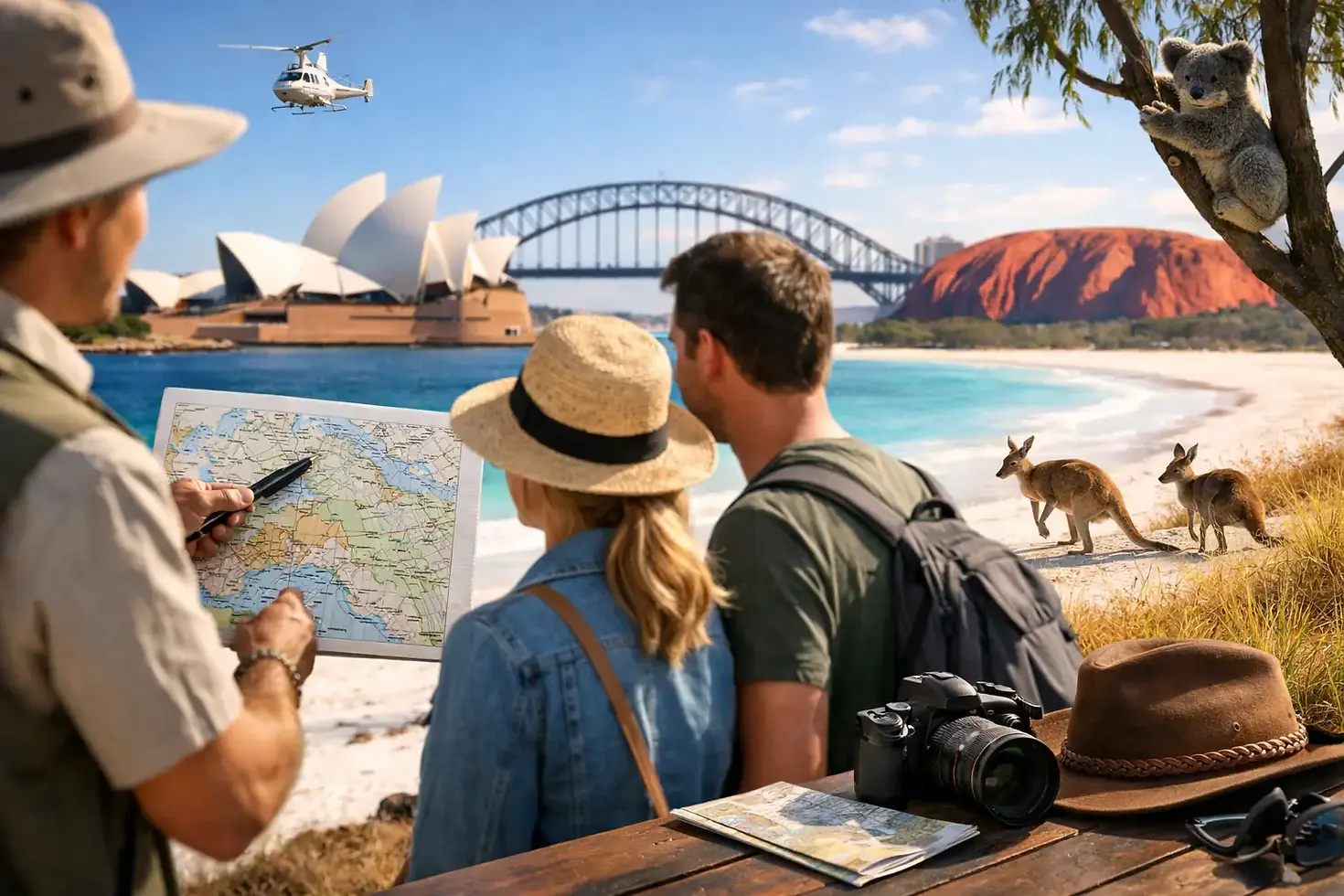
Private Guided Tour Australia Itinerary Tips

Sydney, the Red Centre, and the Great Barrier Reef can all fit into one Australia trip, but not always in the way travelers first imagine. A strong private guided tour Australia itinerary is less about squeezing in every landmark and more about getting the pacing, routing, and style of travel right from the start.
For US travelers, Australia is a long-haul investment in both time and money. That changes how the itinerary should be built. You need sensible flight connections, room for recovery after arrival, and enough flexibility to match your interests - whether that means food and wine, wildlife, luxury lodges, family-friendly touring, or a once-in-a-lifetime honeymoon.
What makes a private guided tour Australia itinerary work
Private touring gives you something fixed group travel usually cannot: control. You are not moving at someone else’s pace, following a rigid bus schedule, or spending valuable vacation time on stops that do not matter to you. Instead, the trip can be structured around your priorities, your energy level, and the kind of service you want on the ground.
That said, private does not automatically mean better unless the itinerary itself is well designed. Australia is vast. Distances are real, and domestic flights can eat into a day more than travelers expect. The best itineraries balance iconic experiences with realistic travel times.
A well-planned route usually answers a few key questions early. How many nights can you actually spend away? Do you want a city-and-nature combination, or a broader overview of the country? Are you happiest with privately guided sightseeing every day, or would you prefer a mix of private touring and independent time? Those choices shape everything that follows.
Start with trip length, not the wish list
One of the biggest planning mistakes is choosing destinations first and trying to force them into a short schedule. In Australia, trip length should lead the conversation.
For around 10 to 12 days, most travelers are better off focusing on two or three regions. Sydney with Uluru and Tropical North Queensland is a proven combination because it gives you city, Outback, and reef or rainforest without trying to cover the whole country. Melbourne can replace Sydney if your interests lean more toward food, arts, and easy access to scenic drives and wine regions.
At 13 to 16 days, you have more room to breathe. This is where a private guided tour Australia itinerary can feel especially rewarding, because there is time for deeper experiences instead of constant repositioning. You might combine Sydney, the Blue Mountains, Uluru, and Port Douglas, or add Melbourne and the Great Ocean Road if coastal scenery is a priority.
Once you move beyond two weeks, the trip becomes more customizable. Western Australia, Tasmania, Kangaroo Island, or a luxury rail segment can start to make sense. The trade-off is that each added destination increases logistical complexity. More variety can be exciting, but it can also make the trip feel fragmented if the transitions are not handled carefully.
The most practical private touring routes
Sydney is often the natural arrival point for US travelers, and it works well as the beginning of the trip. After a long international flight, a private airport transfer, a well-located hotel, and a guided city day can ease you into Australia without pressure. Sydney also lends itself well to private touring because there is so much context to gain from a local guide - harbor neighborhoods, beach culture, history, and dining recommendations all come alive faster when someone knowledgeable is shaping the day.
Uluru is a very different experience and usually works best in the middle of the trip. A private guide here adds real value. This is not just about seeing the rock at sunrise or sunset. The meaning of the landscape, the scale of the desert, and the cultural significance of the area are far more powerful when explained well. Staying at least two nights is usually worth it. One night can feel rushed, especially if flight schedules are not ideal.
For reef time, many travelers do best in Port Douglas rather than splitting time between too many Queensland bases. From there, private or small-scale touring can cover the Daintree, Mossman Gorge, and a reef experience while keeping hotel changes to a minimum. If your priority is marine life and warm-weather downtime, this region often deserves more time than first-time visitors expect.
Melbourne is a strong addition for travelers who want a more urban, cultural contrast to Sydney. It also pairs well with privately guided day touring to the Yarra Valley, Mornington Peninsula, or Great Ocean Road. Still, adding Melbourne only makes sense if you have enough time. If including it means cutting beach or reef time too short, it may be smarter to save it for a return trip.
How private guiding should be used across the trip
Not every day needs to be fully guided. In fact, many of the best itineraries mix private touring with well-chosen independent time. That balance keeps the trip comfortable and prevents it from feeling overscheduled.
Private guiding is especially useful on arrival days, in cities where orientation matters, and in places where local interpretation changes the experience. Sydney, Melbourne, Uluru, and specialized wildlife regions all fit that category. A private guide can help you move efficiently, skip the guesswork, and tailor the day as you go.
On the other hand, some days are better left open. In Port Douglas or the Whitsundays, for example, travelers often appreciate unstructured time around the pool, spa, or beach after several active touring days. A good itinerary protects those quieter pockets instead of treating every day as a checklist.
This is one reason customized planning matters so much. Families may need shorter sightseeing windows and more downtime. Honeymooners may want fewer hotel changes and more premium stays. Active travelers may be happy with early starts and full days, while others want a more relaxed rhythm. There is no single correct formula.
Accommodation and transfers matter more than many travelers expect
In Australia, the hotel location and the transfer plan can change the whole feel of the trip. A cheaper property that adds daily transport headaches is not always a good value. The same goes for very early domestic flights that look efficient on paper but leave you tired and undercut the experience.
With a private guided itinerary, the supporting logistics should feel deliberate. That means airport meet-and-greets when needed, realistic transfer times, and hotels that support what you are trying to do in each destination. In Sydney, that may mean staying near the harbor or in a neighborhood with easy dining access. In the Red Centre, it may mean choosing the lodge level that matches your comfort expectations. In tropical regions, it may mean prioritizing atmosphere and access over the lowest rate.
This is where a full-service planner earns their place. A trip like this involves flights, touring, accommodations, and timing that all need to line up. Downunder Journeys handles those moving parts together, which is often the difference between a trip that looks good online and one that actually works smoothly on the ground.
A sample pacing approach
A well-balanced first Australia trip often starts with three nights in Sydney, followed by two nights in Uluru, then four or five nights in Tropical North Queensland. If the trip is longer, adding three nights in Melbourne can work well. That kind of structure gives each stop a purpose and limits one-night stays, which rarely feel worthwhile on a long-haul vacation.
Could you do more? Of course. But more is not always better. Travelers sometimes ask to add the Whitsundays, Brisbane, Adelaide, and Tasmania into one trip. The honest answer is that it depends on how much time you have and how you want to travel. If every few days involve a flight, transfer, and hotel change, the vacation can start to feel like a series of logistics rather than a memorable experience.
The smarter approach is to choose the right mix of highlights and let each region breathe a little. That is especially true for milestone travel. If this is an anniversary trip, honeymoon, or long-awaited bucket-list vacation, comfort and flow matter just as much as the destination list.
Build for confidence, not just sightseeing
A private guided tour Australia itinerary should do more than show you where to go. It should remove friction. It should account for flight timing, touring style, hotel standards, and the pace that suits you best. It should also give you support if weather shifts, a flight changes, or you simply want the reassurance that someone is overseeing the details.
That is why travelers often choose a specialist rather than trying to piece it together on their own. Australia rewards careful planning. The country is easy to love, but it is not always simple to coordinate from the US without local insight and a clear strategy.
If you start with your timeframe, priorities, and preferred pace, the right itinerary becomes much easier to shape. And when the routing, guiding, and support are all aligned, the trip feels less like a complicated long-haul project and more like what it should be - an extraordinary vacation you can actually enjoy.


Comments